Roof Leak Detection
For Builders and Agents
A dated thermal and visual leak trace your client can book directly, with the report addressed to you, so you are working from evidence rather than a phone call and a guess.
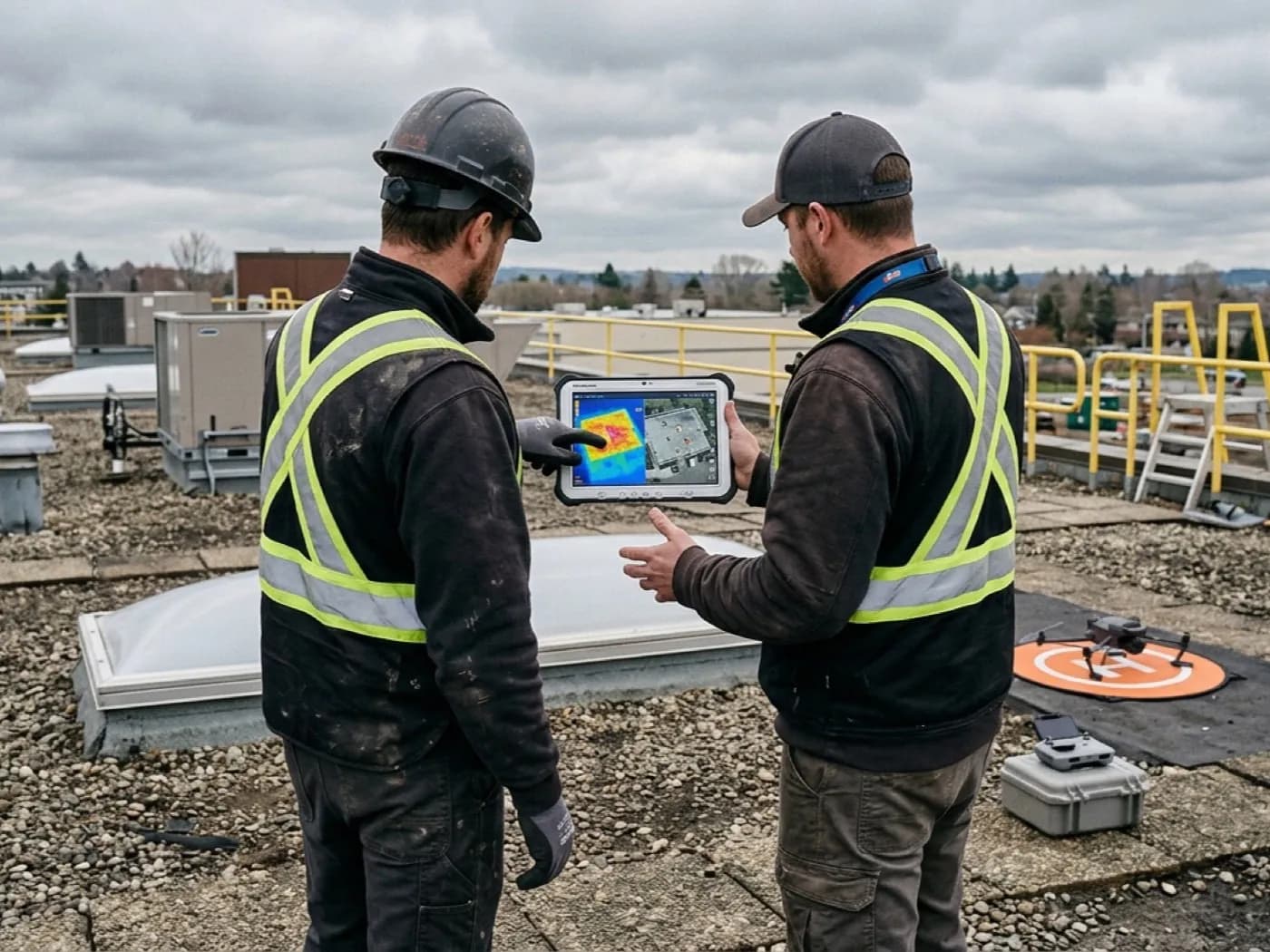
Most jobs on this site start with a roofer, a builder or a letting or managing agent who has already been asked to look at a leak and cannot see enough from the ground, or does not want to send someone up onto a wet roof to go hunting for it. The trace is built to sit alongside that work, not replace it.
Your client can book directly, or you can send the address and what you already know. Either way, the report can be addressed to you as well as the client, so you are quoting the repair from a marked-up set of images rather than from a description over the phone.
The trace does not price the repair and does not compete with your quote. It answers one question, where the water is entering, so the repair conversation starts from evidence instead of a guess.
What is included
- The report addressed to you as well as your client, on request
- Findings written for a trade reader, not simplified past the point of being useful
- No repair pricing in the report, so it never competes with your quote
- Full resolution visual and thermal originals to back up your own assessment
- Dated, photographed evidence a managing agent or insurer can use
- A fixed price agreed before the visit, so it can be built into your own costing
Why the diagnosis and the repair stay separate
The trace does not sell repair work and has nothing to gain from making a small problem sound larger than it is. That is deliberate. A finding that came from someone who also stood to win the repair contract is worth less to you and to your client than one that came from somewhere with no stake in the outcome.
That separation is also why the report is useful to you rather than a threat to your quote. You are the one pricing and doing the work. The trace only answers where the water is getting in, and leaves the rest of the job exactly where it already was, with you.
Evidence for a managing agent or an insurer
Where a leak affects a let property or is part of an insurance claim, the report gives a managing agent or an insurer dated, photographed and thermal evidence of the condition on the day, which is usually the first thing asked for before anything is authorised. It is not a loss adjuster's report and does not replace one, and it says so plainly rather than overstating what it is.
Having that evidence before you open anything up also protects you. If a client or an agent later asks why a repair was carried out where it was, there is a dated record showing what the imagery pointed to at the time, rather than your word against theirs.
Turnaround that fits around your job
A written report within 48 hours of the flight is the standing commitment across the whole business, and flagging that a job is holding up other work gets it scheduled around the weather and thermal conditions rather than simply queued behind whatever was booked first.
On the day
How a for builders and agents runs
- Step 1
You send what you know
The address, what your client has told you, and anything you already suspect. It shapes where the flight spends its time.
- Step 2
Booking around your job
A fixed price and a slot that takes the weather and the conditions for thermal contrast into account, so the imagery is actually usable rather than a token flight on the first available day.
- Step 3
The trace
Visual and thermal passes over the roof, as described on the leak trace page, with particular attention to whatever you have already flagged.
- Step 4
The report
In your inbox and your client's within 48 hours, with the full resolution images so you can zoom into the same detail rather than take a description on trust.
Behind the work
Kit, cover and qualifications
CAA registered
Operator ID and Flyer ID held, plus the A2 Certificate of Competency. Every trace is planned to the rules that apply to the site, and the paperwork is available before the visit if your agent, insurer or a managing agent wants it.
Radiometric thermal
A DJI Mavic 2 Enterprise Advanced carrying a 640 by 512 thermal camera. Water and the material around it hold and release heat differently to a dry roof, which is how a leak gets traced back towards its entry point rather than guessed at from a ceiling stain.
100 megapixel camera
A DJI Mavic 4 Pro with a Hasselblad camera and 6K video, flown alongside the thermal pass. The resolution means a candidate entry point can be shown close up, from a safe standoff distance, without the image falling apart when your roofer zooms in.
Insured with Coverdrone
Full commercial cover for the operation. Certificates go to letting agents, managing agents and insurers as a matter of course, without anyone having to chase for them.
For builders and agents
For Builders and Agents questions
- Can my client book this and have you send me the report?
- Yes. Say so at booking, or have your client mention you, and the report goes to both addresses. There is nothing to set up in advance.
- Do you price the repair?
- No. The report describes what was found and how it looks, and pricing the repair stays entirely with you.
- How quickly can an urgent trace be fitted in?
- There is no fixed same-day slot to promise, because thermal work depends on the weather and the light as much as the diary. Flag that a job is urgent when you book and it gets worked around the conditions rather than queued behind everything else.
Where
For Builders and Agents across the South West
Also on this site
Find the entry point first
Book a leak trace with Roof Leak Detection
Tell us the address and what the leak is doing. Sam Hembury will come back with a fixed price and the next available slot.