Devon · PL1-PL9
Roof leak detection in Plymouth
Leak tracing across Plymouth, from asphalt flat roofs on the rebuilt post-war centre to Victorian terraces on the Hoe, where salt-laden Channel wind reaches well inland across the city.
A rebuilt city of flat roofs and steep streets
Plymouth's post-war city centre was rebuilt largely in flat-roofed commercial blocks, asphalt and single-ply coverings on a scale most of this site's other towns do not have, alongside surviving Victorian terraces around the Hoe, Stoke and Mutley, extensive post-war residential estates, and modern waterfront apartments at Royal William Yard and Millbay. Lead and zinc detailing appears on the older civic buildings, concrete interlocking tile on the estates.
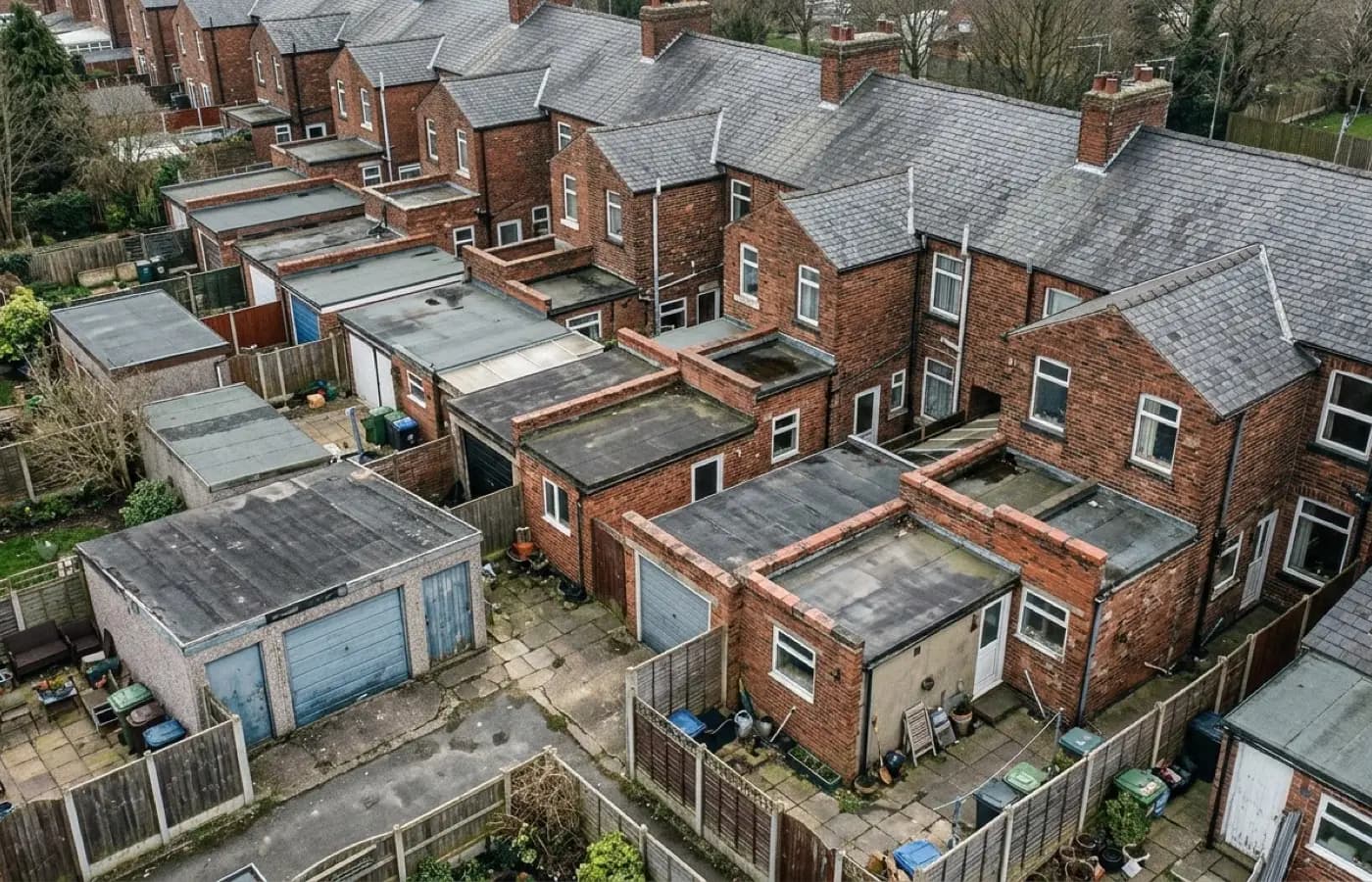
A large flat commercial roof fails differently to a domestic pitched one: ponding on a poorly graded area, a split membrane at a rooflight upstand, or a perished detail around old plant equipment, all spread across an area big enough that a visual pass alone can miss a small but active fault entirely.
Saltash, Ivybridge, Tavistock and Kingsbridge are all close enough to combine into one visit, and each has its own separate page here, because a large flat commercial roof in the city centre and a slate-hung cottage on the Tamar behave nothing alike.
A naval city built for weather off the Sound
Plymouth is built over a series of limestone ridges on the Sound between the Plym and the Tamar, open to south-westerly gales coming straight off the Channel, and that salt-laden wind reaches well inland across the whole city rather than staying near the water. The exposed high suburbs at Crownhill and Southway catch the weather particularly badly despite sitting well back from the seafront.
On a large flat commercial roof, a thermal pass is markedly more efficient than a visual one at finding a leak, because a wet patch in insulation under a membrane can be reading a clear temperature difference from the dry roof around it while showing almost nothing on the surface itself.
The PL1 to PL9 postcode range is the widest single area this site covers in one city, and the airspace check before booking matters more here than almost anywhere else, given the naval and civilian aviation activity around the Sound.
Scale that makes flying the only practical option
Getting a person safely across a large commercial flat roof to inspect every joint and upstand is slow and, on some structures, properly risky, where a drone covers the same area from the air in a fraction of the time without anyone walking the membrane at all.
For the Victorian terraces on the steeper streets around the Hoe and Stoke, the city's characteristic sharp gradients make conventional scaffold access as awkward as anywhere else in this site's coverage, which is the more familiar reason to fly rather than climb.
The Barbican and Sutton Harbour area adds yet another roof type to the city's range, old quayside buildings converted into flats and restaurants, often a mix of original pitched roof and a later flat addition tacked on to make the most of the space. Whichever part of Plymouth a job is in, the fixed price and 48 hour report are the same standard the rest of this site's coverage works to.
Behind the trace
What Plymouth clients are actually buying
CAA registered
Operator ID and Flyer ID held, plus the A2 Certificate of Competency. Every trace is planned to the rules that apply to the site, and the paperwork is available before the visit if your agent, insurer or a managing agent wants it.
Radiometric thermal
A DJI Mavic 2 Enterprise Advanced carrying a 640 by 512 thermal camera. Water and the material around it hold and release heat differently to a dry roof, which is how a leak gets traced back towards its entry point rather than guessed at from a ceiling stain.
100 megapixel camera
A DJI Mavic 4 Pro with a Hasselblad camera and 6K video, flown alongside the thermal pass. The resolution means a candidate entry point can be shown close up, from a safe standoff distance, without the image falling apart when your roofer zooms in.
Insured with Coverdrone
Full commercial cover for the operation. Certificates go to letting agents, managing agents and insurers as a matter of course, without anyone having to chase for them.
Nearby
Also covered around Plymouth
- SaltashLeak tracing in Saltash, on near-vertical waterfront streets under the two Tamar bridges, where slate-hung villas and flat garage roofs both take the estuary's salt-laden wind hard.
- IvybridgeLeak tracing in Ivybridge, an overwhelmingly late twentieth century commuter town on Dartmoor's southern edge, where moor-driven wind tests ridge and verge fixings estate after estate.
- TavistockLeak tracing in Tavistock, where a Victorian mining-wealth town of Hurdwick stone and tall stacks sits on Dartmoor's edge, taking rain up the Tamar valley from the south west.
Find the entry point first
Book a leak trace in Plymouth
Send the address and what the leak is doing. Sam Hembury will come back with a fixed price and the next slot that suits the weather.